

The short version
Modular systems suit most exhibitors most of the time; fully custom builds earn their cost when you need something a modular system genuinely can't do. The decision isn't about which looks more impressive, because a well-designed modular stand can look every bit as striking as a custom build. It's about whether you need one specific, unrepeatable structure or a system that reconfigures across shows.
Modular vs Custom at a Glance
| Modular | Fully custom build | |
|---|---|---|
| Price | Fixed-price packages from £4,203 + VAT | Priced per design |
| Reuse | The frame is rebuilt in new sizes and layouts | Usually built for one stand and one show |
| Lead time | Order about five weeks before the show | Allow longer for design and fabrication |
| After the show | Hire frame goes back into stock; you keep the graphics | Stored at a cost, or disposed of |
| Best for | Most shows, changing stand sizes, budget certainty | A one-off structure a frame system can't make |
When Modular Makes Sense
If you exhibit more than once a year, change stand size between shows, or want to control cost without giving up design quality, modular is almost always the right call. Systems like T3 and Aluvision reconfigure into different footprints and layouts, so the same kit can be a 3m x 3m stand at a regional show and part of a 6m x 6m island at your flagship event. It is also faster to design and build, which matters when your lead time is tight.
When a Custom Build Earns Its Cost
A fully custom build makes sense when your stand needs to do something a modular system structurally can't: an unusual architectural shape, a one-off flagship structure for a single major show, or a design so specific to one space that reuse was never the point. Custom builds cost more and take longer to design, and that cost only pays off when the show itself justifies a stand you are unlikely to reuse in the same form.
The Real Cost Comparison
Our modular package stands are fixed-price hire, exactly as shown in the Stand Selector, all excluding VAT: a 4m x 3m costs from £4,417 to £6,637 depending on the design and wall height, a 6m x 4m from £4,909 to £8,449, and island packages start at £5,315. That price covers design, printed graphics, the stand system, delivery, build and dismantle. Custom stands are priced per design, depending on what is included, the location and the build time. See our full cost breakdown for what drives the price, and the hire vs buy guide if ownership is part of your decision.
A Middle Ground: Custom-Look Modular
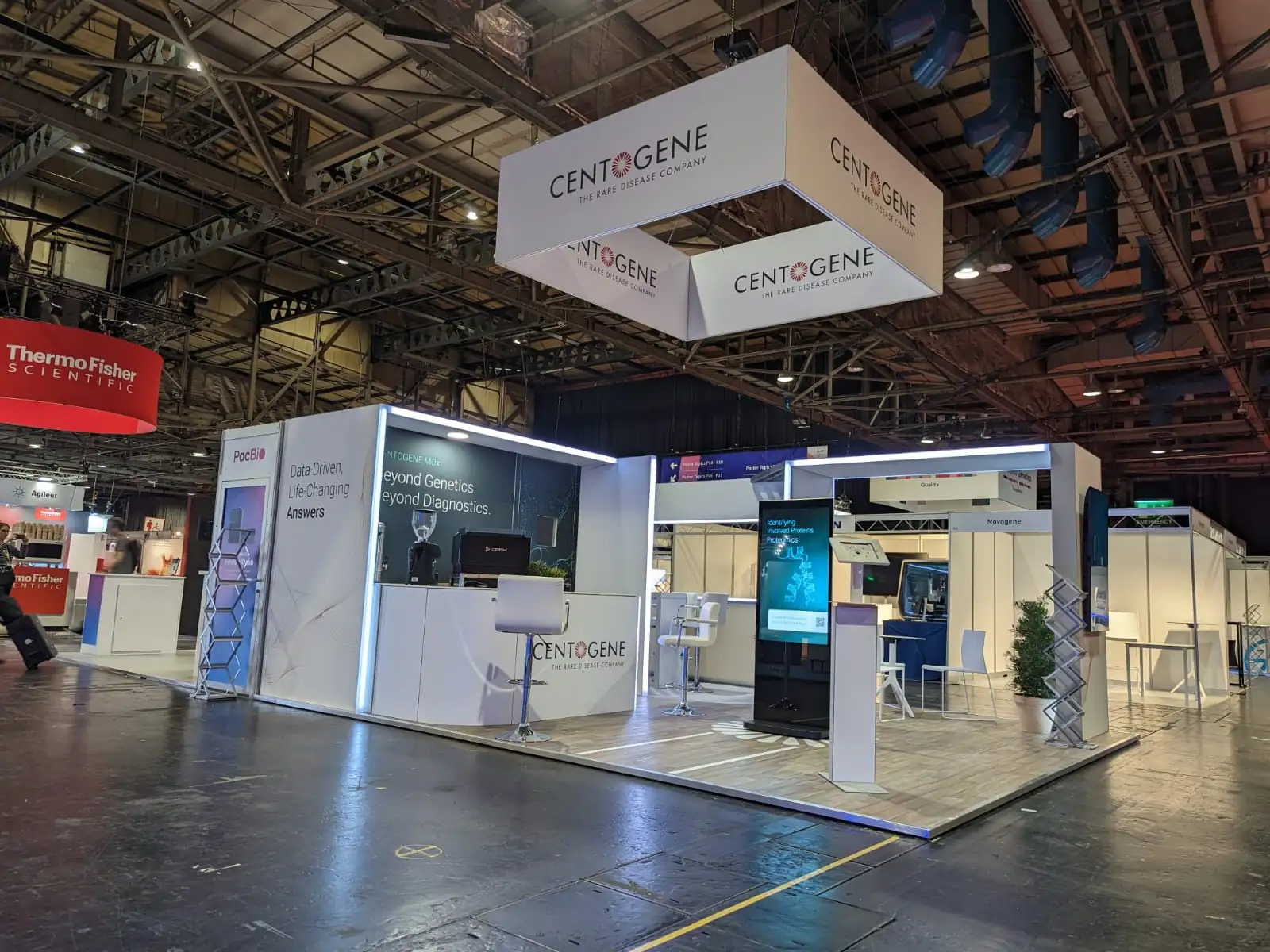
Modern modular systems get closer to a custom look than most exhibitors expect: seamless fabric graphics edge to edge, LEDline and backlit lightboxes, towers, storerooms and meeting rooms built into the frame. Custom modular stands are designed around your brief rather than chosen from a catalogue, then built from reusable stock. If you are drawn to custom purely for the look rather than a one-off structural need, ask what a modular system can achieve first. Our custom exhibition stands are built this way.
Wall Heights and Sizes
Space-only package stands come with 2.5m, 3m or 3.5m walls, and shell scheme packages use 2.36m walls to fit inside the organiser's shell. Custom modular stands can go to other heights, up to 4m on the simple stands we build. Every layout works: inline, corner, peninsula or island.
What Happens After the Show
On a modular hire stand, the frame comes back into our stock, the consumables are recycled and you keep your graphics, so there is nothing to store. A custom build is yours: it has to be stored between shows or disposed of, and one-off custom pieces that won't be reused are usually better replaced with a fresh design next time. That difference is also why modular is the lower-waste choice, and it is part of our ESSA Tier 5 sustainability accreditation (2026).
What Modular Looks Like in Practice
Three recent modular stands at the SEC Glasgow show the range. SSI Schaefer took a 3m x 3m corner stand on T3 at Manufacturing & Supply Chain Expo 2026. Acubed.IT built a 6m x 6m island on T3 at CYBERUK 2026. Shepherd & Wedderburn returned to All Energy with a 6m x 5m Aluvision peninsula. None of them is a one-off structure, yet none looks like a kit: the graphics, lighting and layout were designed for each brief. More examples are on Our Work.
Questions to Ask Before You Decide
- Will we exhibit again at a similar size within the next year?
- Does the design need a shape a frame system can't make, or just a distinctive look?
- Where will a custom stand be stored between shows, and who pays for it?
- How much time is there before the show? Aim to order a build about five weeks ahead.
How to Decide in Five Minutes
- One show, one shape that only a custom structure can make: custom build.
- Several shows, or sizes that change: modular hire.
- The same size several times a year: consider buying a modular stand, which tends to pay for itself in about three shows.
- Not sure: send us the brief and we will price the options side by side, with a free 3D design in 48 hours.
For prices, systems and the hire, buy and own-kit options in one place, see modular exhibition stands.
Before
After
Redblu in practice
Frequently asked questions
Is a custom exhibition stand better than modular?
Not automatically — well-designed modular stands can look just as striking. Custom earns its cost when you need a genuinely one-off structure a modular system can't achieve.
Can modular stands look as good as custom builds?
Often, yes — modern systems support distinctive shapes and integrated features like LED tile walls, closing much of the visual gap with fully bespoke builds.
Is modular cheaper than custom in the long run?
Usually — especially if you exhibit more than once, since the same modular investment reconfigures across shows rather than being a single-use structure.
When should I choose a fully custom build?
When your design needs something structurally beyond what a modular system offers, or for a single flagship show where a one-off structure is the point.
Which modular exhibition stand system does Redblu recommend for flagship shows?
It depends on priorities — T3 suits speed and reconfigurability across regional shows, while Aluvision suits flagship events wanting LED integration and a premium finish. Our design team can advise which fits your show calendar.
The takeaway
Planning your exhibition stand?
You might also want to know: